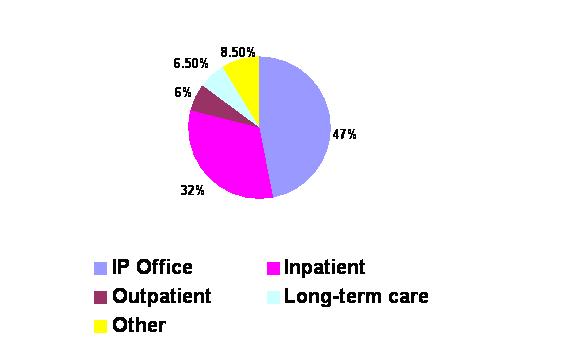
The study also provides an informative look at the changing role of today's IPs. The table below summarizes how today's IPs spend their time:

Abstract and link to full text here


 NDM-1 is a gene that makes bacteria highly resistant to many classes of antibiotics. The bacteria originated in India, where unregulated use of antibiotics is common. The MGH patient had recently traveled to India, had spent time in a hospital there, and was undergoing cancer treatment at MGH when the bug was discovered. Two other cases have also been identified in California and in Illinois.
 During a recent visit to Toronto hospitals, I learned firsthand how the SARS outbreak affected infection prevention departments specifically and health care workers in general. I decided to do some background research on the outbreak and picked up Thomas Abraham’s Twenty-First Century Plague: The Story of SARS. It’s a quick read at 176 pages and takes the reader from SARS’ origins in southern China, tracking the disease step-by-step as it emerges in major cities, spreads internationally, and is eventually thwarted by the efforts of the global health community led by the World Health Organization. Some highlights include: the unusual transmission of SARS via bathroom drains and apartment building plumbing, how health care workers risked and lost their lives to control infections, and how network-enabled collaboration helped spread successful prevention strategies just in time.
 Lately, there has been a lot of buzz on using social networks to change
health behavior. Ron blogged earlier about Nicholas Christakis' book
Connected, this week a new research study came of out of MIT that shows that when it
comes to changing health behavior, having fewer friends that one knows
really well is better than having many friends whom one doesn't know well.
Professor Damon Centola from the MIT Sloan School of Management tracked
the number of people who registered for a health forum from two distinct
social networks. In one social network, participants had "long ties" with
each other, meaning each participant knew many different people but didn't
know them well. In the other social network, participants formed "dense
clusters," meaning each of them knew fewer people but knew them very well.
The study result showed 54% of the people from the dense clusters network
registered for the health forum and 38% from long ties network did. This
study suggests that policies may be more effective when aimed at
communities and groups that act as clustered networks.
More about Professor Centola's study
On a side note, there is a funny YouTube video on health care executives’ response to the bill.
There’s been plenty of talk on Google Flu Trends since it launched in early 2009 in the midst of H1N1. Twitter and other Web 2.0 platforms are similarly being used to track syndromic trends to detect early outbreaks. CDC has even suggested that as retail health clinics like RediClinic and MinuteClinic, with their modern IT infrastructure and national presence, serve as early detectors of syndromic trends.
As personal health records gain in adoption, these could also provide opportunities for de-identified surveillance for targeted syndromes.

 There are so many interesting talks at APIC that there is not enough time to digest it all. A couple topics that I want to expand on in later posts (but want to mention in this post) are 1) How IPs can reposition their roles and their department as revenue centers as opposed to cost centers and, 2) Controversies on hand hygiene compliance, and 3) NOLA cuisine.
Dr. Dan Diekema recently blogged about a new study published in JAMA that shows that respiratory tract MRSA carriage/infection is linked to high mortality in cystic fibrosis patients. He raises an interesting question about why MRSA, and not MSSA, is associated with worse outcome among cystic fibrosis patients especially since there is no evidence to show that MRSA is intrinsically more virulent than MSSA (Now, this is debatable as there are studies that show that MRSA is more virulent than MSSA, however the justifications behind why this is the case are controversial).
Nevertheless, Dr. Diekema’s question reminded me of an article I read on toxoplasma in last week’s Economist. Toxoplasma is a pathogen that’s a close cousin to Plasmodium, the bug that causes malaria. However, despite its high prevalence, symptoms among people infected with toxoplasma are mild and the bug doesn’t seem to cause a lot of damage, UNTIL scientists discovered that rats infected by toxoplasma exhibit more risky behavior, which suggests that the bug is interfering with the brain.
A separate study on toxoplasma in humans found that people involved in road accidents were almost three times more likely to be infected by toxoplasma than those who had not been. Some are going as far as saying that toxoplasma is altering the culture of entire societies.
So, here is my theory to answer Dr. Diekema’s question, maybe MRSA is affecting patients’ psychology and/or behavior in a way similar to that of toxoplasma? Or could it be that MRSA colonization/infection leads to higher susceptibility to toxoplasma infection, which leads to more risky behavior? i.e. not following hand hygiene compliance. I wonder what kind of study we can do to prove my theory.
We opt, however, for the metaphor of a long journey. The problem is massive and it will require unity, focus, and resources. However, arriving at lower infection rates and establishing an improved patient safety culture will figuratively require us to “be at a different place”. A safe health care system with minimal levels of healthcare-acquired infections will look much different than where we are today.
In the midst of all this, we are already taking the first positive steps. HHS Secretary Sebelius recently declared an early victory with the news of an 18 percent decrease in national CLABIs in hospitalized patients. Success stories such as that in the state of Michigan also bode well for long-term success.
The purpose of this blog is to document our collective journey to zero HAI-related deaths. We’ll explore the varied and innovative efforts of individuals, groups, and governments. We’ll build a supportive virtual community to share best practices, provide moral support, and collaborate. Dr. Atul Gawande of Brigham and Women’s Hospital in Boston recently characterized the HAI problem as “the easiest 100,000 lives we can save.” We share Dr. Gawande’s optimism, and we are excited to document the successes, stories, and challenges in our collective journey.
MRSA, or Methicillin-resistant Staphylococcus aureus, is responsible for an estimated 19,000 deaths a year in the U.S. and costs hospitals an additional $60,000 per patient who acquires a MRSA infection in the hospital. In October 2006, APIC conducted the first-ever national MRSA prevalence study and found that 46 out of every 1,000 patients in the study were either infected or colonized with MRSA. The rate was larger than previously estimated and led to several concerted efforts by APIC to combat MRSA. The goal of this year’s survey is to update the study results with the current MRSA prevalence rate. The comparison will help evaluate the impact of recent MRSA prevention measures on MRSA prevalence.
The Centers for Medicare & Medicaid Services (CMS) has not yet begun to penalize hospitals with high MRSA infection rates by reducing reimbursement. However, given the current trend that focuses on pay-for-performance, it’s likely that CMS will refuse to pay for preventable MRSA infections in the future.
Therefore, I urge every hospital to participate in this important survey. After all, how do we fight MRSA if we don’t know what kind of problem we are dealing with? The survey results affect the measures and solutions we adopt, the amount of resources we need and receive, the type of care we provide to patients, and the kind of research and innovation that will be necessary to combat the infection.

